
 From General Bounce: The Lady and the Locusts, a nineteenth-century novel:
’Tis a pity we should think so little of payment till the bill comes due;—in the meantime we go blindly on, deceiving and deceived—we know but little of our neighbour, and we trust in heaven our neighbour knows nothing whatever about us; so we grope about in the dark, and call it Life.
I’m not chary of bringing up the “payment,” that is, final judgment, but my interest here is the “deceiving,” the secrecy.
We learn secrecy from being with other people—most of us from growing up in families. Not “keeping secrets,” that is, other people’s secrets, but each individual of us having our own carefully kept and guarded thoughts that those who know us best have no idea of and carrying out actions out of the presence and knowledge of those same people.
We learn this secrecy in our families as the clearest lesson from parental correction. The lesson is not that I shouldn’t do what mom or dad don’t want me to do but that I should do it in such a way that they don’t see, don’t know, or at least don’t notice. So subterfuge wins over compliance. Not that we’re all so evil or sneaky but that that secrecy is, in fact, the most logical and sensible lesson learnable from parental correction. And it’s a lesson that shapes how we live henceforth.
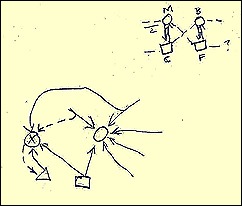
General Bounce: The Lady and the Locusts is about love and romance. I drew the diagrams shown above to help keep things straight. The larger diagram came before the midpoint, by which time some of those six arrows (the locusts) pointing toward that circle (the lady) had been rejected or were giving up the fight in view of a rumor that the lady would not, after all, inherit the fortune. The smaller diagram is for the last few chapters when only four possible lovers, two of each gender, remained.
Looking back, I realize now that the novel is, beginning to end, all about that secrecy we maintain among ourselves. It would have been much shorter if the characters had been sensible and conferred among themselves. But we don’t do that, and they didn’t. As it is, they all thought they understood, or at least acted in accord with their guesses at each other’s minds. Some of those wrong guesses and incorrect assurances are represented by dotted lines in the diagrams.
It does no good for the frustrated reader to try to call the characters’ attention to those sorts of problems. I tried.
-
George John Whyte-Melville, General Bounce; Or, The Lady and the Locusts (1854). The quotation is from chapter 3 (of 27). The author, so I’ve read at Wikipedia, generally included sporting events, especially the now forbidden foxhunts, in his books. I generally skim through those parts quickly just to find out who gets injured and how badly. Equally forbidden nowadays are the assumptions about racial differences held by the characters, but we the readers should not then transfer those assumptions onto historical differences and get mad at the author about it.
-
I was thinking it was just coincidental, but it can hardly be: I sat down to type up something on secrecy and how we learn it in our families, paused to put something in my headphones, and hit on, without thinking about it, the Cranberries (Bury the Hatchet), but no, too neat to be coincidence. Part of my secret life, by the way, might be enjoying bouncy pop-rock, and a solo trumpet in it is a special delight.
 The One Story
2 thoughts on “General Bounce 1: Secrecy”